
How to Prepare for Your Analyst Assessment
It all starts with a three-stage screening
Screening
Everything begins with alignment. We typically partner with analysts who bring 4+ years of experience from high-performing environments like MBB, the Big 4, top-tier consulting, banking or high-growth tech.
If your background matches our current needs, you’ll move directly to our Test Project. In many cases, a Gratia recruiter will also reach out to chat about your career journey, your aspirations, and practical details like availability and rates.
Test project
This is your opportunity to showcase your real-world execution ability through a 3-4 hour project simulation. You’ll receive a brief and have a 3-5 day window to submit your deliverables.
What defines a standout project?
- Don't just provide data—provide a narrative and clear recommendations.
- We look for sound logic, well-documented assumptions, and an understanding of how different variables impact your results.
- High-quality visuals and a structured flow that a client could easily follow.
AI interview
After submitting your project, you’ll be invited to an innovative, AI-powered video interview via TestGorilla. This stage is designed to be an objective, bias-free space focused entirely on your unique skills.
The AI will ask follow-up questions specific to your project submission—this is your time to explain your "why" and how you validated your work. We’ll also explore your approach to taking ownership, building trust, and effectively scoping projects.
After this round, our Talent Manager will schedule a brief, collaborative alignment call to finalize your path toward an offer. It’s the perfect time to ask any remaining questions as we coordinate the details for your start timing and logistics.
Final check-in
This is a brief, collaborative alignment call to finalize your path toward an offer or bench approval. It’s the perfect time to ask any remaining questions as we coordinate the details for your start timing and logistics.
What makes you stand out
What counts
- You communicate your logic and career story clearly using the Situation → Approach → Output → Impact framework.
- You are a self-starter who proactively drives work forward and anticipates project needs.
- You can clearly demonstrate how your work has shifted a business outcome and created value.
What doesn’t count
- Internships
- Short-term freelance work
- Unrelated or non-technical experience
- Academic projects only
Make your screening a success

Keep your CV & LinkedIn up to date
Make sure your experience, skills, and recent projects are current and consistent across your CV and LinkedIn. Add specifics (tools, outcomes, scope) so reviewers can quickly understand your level and fit.

Show up like you would with a client
Join from a quiet place with stable Wi‑Fi, turn your camera on, check your background, and dress professionally. Treat the call as a client-facing moment—clarity and presence matter.

Prepare a relevant case to talk through
Come ready to walk through one strong example of work that’s relevant to the role (context → your approach → impact). Focus on decision-making, tradeoffs, and measurable outcomes not just tasks.

Plan for one focused sitting
The skill assessment should be completed in a single sitting. Block uninterrupted time, minimize distractions, and be ready to explain your thinking clearly as you work.
What happens after you pass
Your impact path at Gratia
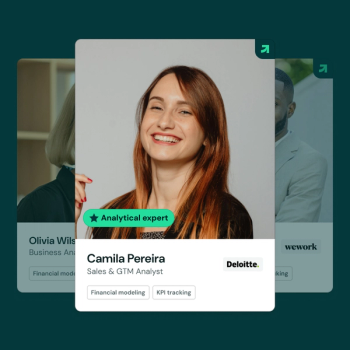
We believe in placing every analyst in a position where they can thrive. During the assessment process, we’ll look at your technical strengths and communication style to match you with the level that best fits your expertise:
Associate (A2) — You take clear instructions and deliver high-quality, reliable output. You partner closely with a Manager or Senior analyst, flagging any gaps in data or context immediately and delivering work in 4–6 hour increments for quick feedback and alignment.
Analyst (A3) — You own the project momentum and solutioning. You proactively secure information directly from the client. You operate on daily work cycles and escalate to Gratia only when facing significant external bottlenecks.
Senior (A4) — You serve as a Subject Matter Expert and trusted advisor for. You independently navigate complex client environments and handle the most intricate challenges, setting the quality standards for the entire scope of work with minimal oversight.

Frequently Asked Questions
Questions about the process?
Ready to break your local ceiling?
Related pages
See also: Analyst roles at Gratia, Gratia in Latin America, About Gratia.